Most discussion of sport videography in Scotland focuses on kit: which camera, which lens, which stabiliser, how many frames per second. Those things matter, but they are not what separates sport footage that works from sport footage that does not. The difference is knowledge of the sport itself, and that is something I learned not behind a camera but in front of a results screen, working as a performance analyst on the UCI Mountain Bike World Cup circuit.
What a performance analyst actually does
Before I made my living filming sport, I spent years studying it analytically. A performance analyst breaks down movement, reads races, and identifies the micro-decisions that separate a podium finish from a mid-field result. You learn to see what an athlete is about to do before they do it: how a rider sets up for a technical section, where a race is won and lost, what a body looks like in the moments before it commits to a difficult line.
That training rewires how you watch sport. You stop reacting and start anticipating. And when you turn a camera on athletes with that habit of mind, the footage changes completely.
It sat alongside years of racing. I competed in triathlon and cross-country mountain biking at national elite level, and was captain of the University Cycling Club at St Andrews while completing a PhD in geomorphology, so the analysis came after a long apprenticeship as an athlete rather than instead of one.
Anticipation is the whole game
The single biggest weakness in amateur sport filming is that the camera is always a beat behind. The operator reacts to the action, which means they capture the aftermath rather than the moment. Sport filmed by someone who understands it from the inside is different: the camera is already where it needs to be because the operator knew what was coming.
When we filmed Mark Beaumont riding the Hebridean Way in 24 hours, this was the entire production discipline. Filming a sustained athletic effort across 185 miles of the Outer Hebrides meant constantly reading where Mark was in his ride, both physically and mentally, and positioning ahead of the decisive moments rather than chasing them. You cannot do that without understanding what the effort actually costs.
Reading a course before the race
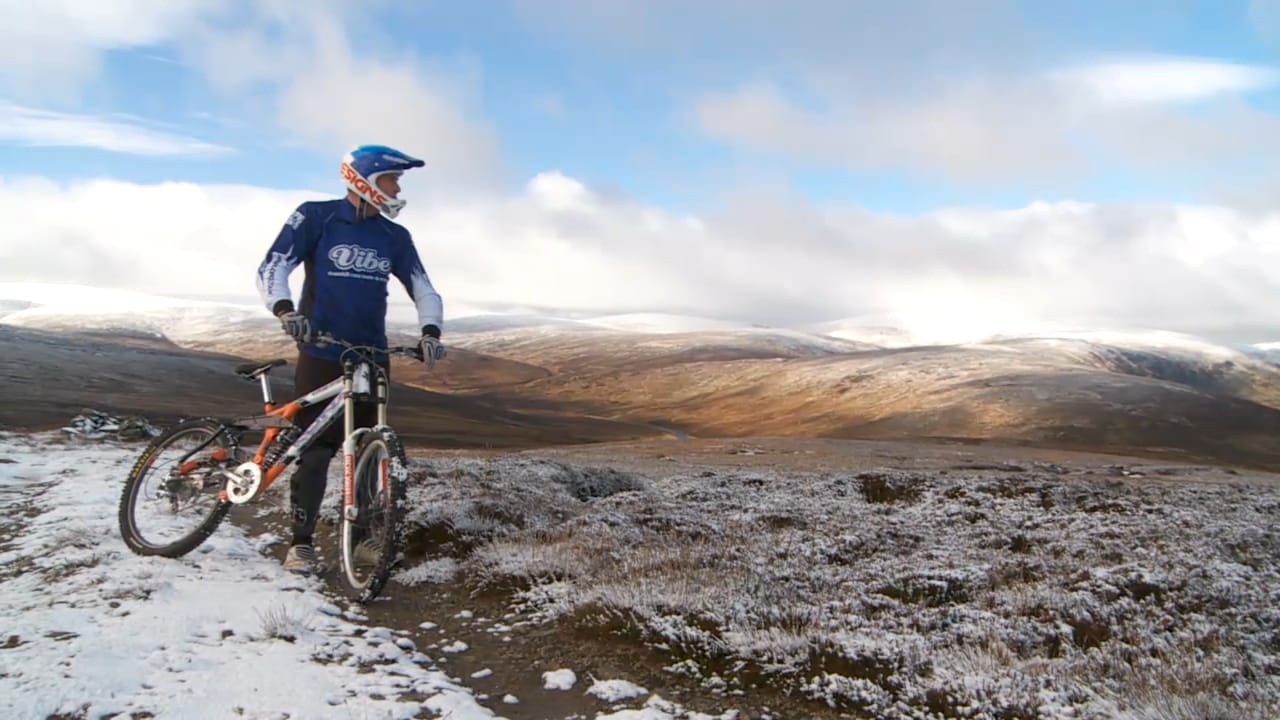
Mountain bike racing is the clearest case. A course has a small number of places where the race is actually decided: a technical rock garden, a tight switchback, a steep chute where line choice matters more than fitness. A rider who has raced knows where they are within a minute of walking the course. A camera operator who has not will spread the coverage evenly and miss most of them.
Our promotional film for the Fair City Enduro, the mountain bike event run in and around Perth by Muckmedden Events, depended on exactly that. Enduro stages are long, and the riders come through any given point once. Knowing in advance which sections would show the riding at its best, and where a rider would be committed and visible rather than braking and out of shape, decided where the camera stood before the first rider dropped in.
Steep ground, and the camera in the same conditions
On some sports the operator does not get to stand safely on the bank. In Comfort Zones, a twelve-minute documentary on steep skiing at Glenshee, I filmed in the same terrain as the skiers. Steep ground limits what can be carried and where it is safe to stand, and it means the shot has to be chosen before the position is committed to, because there is no walking back up for a better angle.
That is anticipation of a different kind: deciding what the run will look like before it happens, then setting up for it with no margin. The film was selected by six festivals in 2019, including Kendal Mountain Festival and the Sheffield Adventure Film Festival, which is the nearest thing a self-initiated film gets to an independent verdict.
Anticipation in the edit, not just the camera
Reading sport is not only about where the camera stands. It shapes the structure of a film. For the Cateran Yomp 2026, the official film of a fifty-four mile endurance event across highland Perthshire in aid of the Army Benevolent Fund, we filmed participants on the Friday describing what they expected the night to do to them. One predicted that at three in the morning he would be in some pain and probably some regret. The film plays that prediction back over the night itself.
That structure only works if you know in advance where an endurance event will break people: not at the start, and rarely at the finish, but somewhere in the small hours when the novelty has gone and the distance remaining is still enormous. Anyone who has raced long distances knows roughly when that will be. The camera has to be there for it, and the edit has to be built to receive it.
Reading the athlete, not just the action
There is a human dimension to this too. The most compelling sport footage is rarely the action shot; it is the face, the body language, the moment of doubt or commitment. Knowing sport from the inside means knowing when those moments are coming and giving them room. It also means earning the trust of the athletes you film, because they can tell immediately whether the person behind the camera understands what they are doing.
The same holds at grassroots level. Our film for Perthshire Rugby, shot close to our own base, was built around the club’s identity and community rather than an imitation of broadcast coverage. Club sport has different moments from professional sport, and a different audience, and the film has to know which ones matter to the people in it.
Why this matters for sport videography in Scotland
Scotland is an exceptional environment for sport and adventure filmmaking: mountain biking, ski mountaineering, trail running, climbing and cycling all happen here in landscapes that add drama to any frame. But the landscape is not enough on its own. Our clients in this space include the BBC, Scottish Rugby, British Cycling and Scottish Cycling, alongside individual athletes and event organisers, and the work rests on the analytical and athletic understanding that lets us film a sport accurately and with feeling.
The crew has to be able to get there
Sport and adventure filming in Scotland also demands a crew that can operate in demanding outdoor conditions without being guided to locations or briefed on how the sport works. That self-sufficiency is not a luxury; on a two-day mountain shoot where conditions change every hour, it is the difference between getting the film and missing it.
Some of this work now sits with Quiet Eye Productions, the sister company I co-founded in 2024, which takes broadcast-standard sport documentary and adventure film commissions. Morrocco Media continues to make sport and adventure films for brands, events and athletes. Which company a project belongs with depends on its scope and format, and we say so at the first conversation.
If you are planning a sport or adventure production, our sport and adventure filmmaking service explains how this background shapes the work we do.
Frequently asked questions
Can you film live sporting events?
Yes. Live events are a large part of the work, from the Fair City Enduro in Perth to the overnight Cateran Yomp, and we deliver in all standard broadcast and digital formats. Sport clients have included the BBC, British Cycling and Scottish Rugby, where our work is for the game development side: conference filming and skills-based coaching videos. Understanding the sport means the camera is in position for the decisive moment rather than chasing it.
Do you film individual athletes as well as organisations?
We do. Alongside governing bodies and event organisers, we work with individual athletes on personal brand content and sponsor films. The same principle applies: filming an athlete well depends on understanding their sport from the inside, not just owning a long lens.
How much does sport videography cost in Scotland?
Morrocco Media charges £650 for a full day, £400 for a half day and £110 per hour, and those rates cover both filming and editing with all equipment included. As a rule of thumb, one day of filming needs around two days of editing. Shoots in remote or weather-dependent locations sometimes need contingency days, which we discuss at the quoting stage.
Do you film endurance and mass-participation events?
Yes. Recent examples include the official film of the Cateran Yomp 2026, a fifty-four mile walk across highland Perthshire for the Army Benevolent Fund, and earlier event work such as the Fair City Enduro mountain bike race in Perth. Long events need the crew to move through the night with the participants, which is a planning question as much as a filming one.
What does “filming sport from the inside” mean in practice on a shoot?
In practice it changes where the camera is and when it rolls. An operator who understands a sport is positioned for the decisive moment before it happens rather than reacting to it afterwards, so the footage captures the action at its peak instead of its aftermath. It also shapes the relationship with the athletes: when the people on camera can tell the filmmaker genuinely understands what they are doing, they trust the process and perform naturally rather than self-consciously. And it informs the edit, because someone who reads the sport knows which moments carry the real drama. None of this comes from equipment; it comes from years spent analysing and participating in sport, which is exactly the background behind Morrocco Media’s work in this field.